Dewey on Education by Martin S. Dworkin
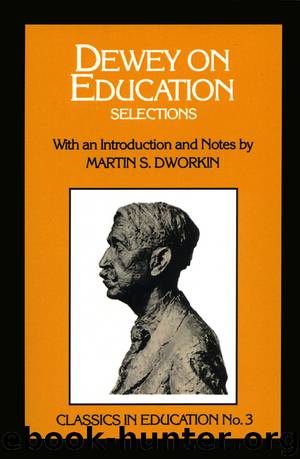
Author:Martin S. Dworkin
Language: eng
Format: epub
Publisher: Teachers College Press
Published: 1959-05-12T04:00:00+00:00
The school system, upon the whole, has grown from the top down. During the middle ages it was essentially a cluster of professional schools—especially law and theology. Our present university comes down to us from the middle ages. I will not say that at present it is a mediæval institution, but it had its roots in the middle ages, and it has not outlived all mediæval traditions regarding learning.
The kindergarten, rising with the present century, was a union of the nursery and of the philosophy of Schelling; a wedding of the plays and games which the mother carried on with her children, to Schelling’s highly romantic and symbolic philosophy. The elements that came from the actual study of child life—the continuation of the nursery—have remained a life-bringing force in all education; the Schellingesque factors made an obstruction between it and the rest of the school system, brought about isolations.
The line drawn over the top indicates that there is a certain interaction between the kindergarten and the primary school; for, so far as the primary school remained in spirit foreign to the natural interests of child life, it was isolated from the kindergarten, so that it is a problem, at present, to introduce kindergarten methods into the primary school; the problem of the so-called connecting class. The difficulty is that the two are not one from the start. To get a connection the teacher has had to climb over the wall instead of entering in at the gate.
On the side of aims, the ideal of the kindergarten was the moral development of the children, rather than instruction or discipline; an ideal sometimes emphasized to the point of sentimentality. The primary school grew practically out of the popular movement of the sixteenth century, when along with the invention of printing and the growth of commerce, it became a business necessity to know how to read, write, and figure. The aim was distinctly a practical one; it was utility; getting command of these tools, the symbols of learning, not for the sake of learning, but because they gave access to careers in life otherwise closed.
The division next to the primary school is the grammar school. The term is not much used in the West, but is common in the eastern states. It goes back to the time of the revival of learning—a little earlier perhaps than the conditions out of which the primary school originated, and, even when contemporaneous, having a different ideal. It had to do with the study of language in the higher sense; because, at the time of the Renaissance, Latin and Greek connected people with the culture of the past, with the Roman and Greek world. The classic languages were the only means of escape from the limitations of the middle ages. Thus there sprang up the prototype of the grammar school, more liberal than the university (so largely professional in character), for the purpose of putting into the hands of the people the key to the old learning, that men might see a world with a larger horizon.
Download
This site does not store any files on its server. We only index and link to content provided by other sites. Please contact the content providers to delete copyright contents if any and email us, we'll remove relevant links or contents immediately.
The Art of Coaching Workbook by Elena Aguilar(51379)
Trainspotting by Irvine Welsh(21966)
The Secret History by Donna Tartt(19465)
Twilight of the Idols With the Antichrist and Ecce Homo by Friedrich Nietzsche(18775)
All the Missing Girls by Megan Miranda(16685)
Cat's cradle by Kurt Vonnegut(15550)
Ready Player One by Cline Ernest(15139)
Talking to Strangers by Malcolm Gladwell(13534)
Fangirl by Rainbow Rowell(9460)
The remains of the day by Kazuo Ishiguro(9211)
The Compound Effect by Darren Hardy(9145)
Thirteen Reasons Why by Jay Asher(9110)
Tools of Titans by Timothy Ferriss(8590)
Periodization Training for Sports by Tudor Bompa(8414)
Wonder by R. J. Palacio(8238)
A Court of Wings and Ruin by Sarah J. Maas(8106)
The Lover by Duras Marguerite(8042)
Change Your Questions, Change Your Life by Marilee Adams(7928)
Giovanni's Room by James Baldwin(7538)
